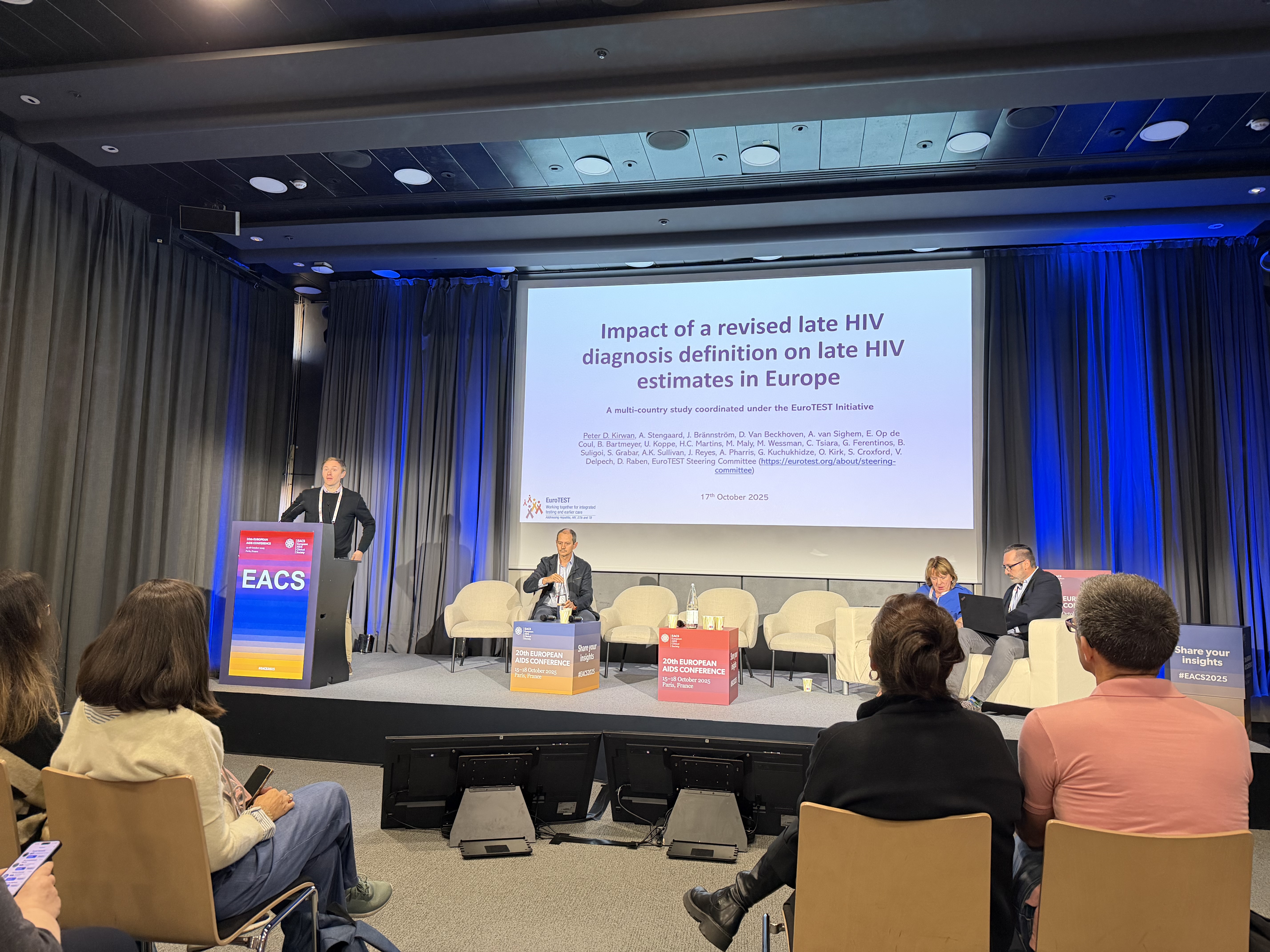
Revised definition of HIV late diagnosis
2022 work – revising the 2010 definition of late diagnosis
In 2010, a consensus definition was published in which late presentation of HIV was defined as presenting for HIV care having a CD4 count <350 cells/µL or with an AIDS-defining event. Increasing HIV testing frequency in recent years has led to more diagnoses during seroconversion, when CD4 counts may be temporarily low, causing overestimation of late diagnoses.
To improve distinction between people diagnosed late with HIV from those recently infected, a EuroTEST expert group was convened in January 2022, supported by ECDC, EACS and WHO/Europe. The group – comprising clinicians, epidemiologists, public health professionals and civil society representatives – revisited the existing consensus definition and reviewed the feasibility of including data on markers of recent infection. A survey on the availability of data needed for implementing the revised definition and reclassifying people with low CD4 cell count due to recent infection across the WHO European Region was conducted from April to June 2022.
This resulted in the publication of the paper “Late diagnosis of HIV: An updated consensus definition” (Croxford et al, 2022), presenting the revised definition of late HIV diagnosis according to which people diagnosed during seroconversion should reclassified as ‘not late’ based on (in hierarchical order) i) laboratory evidence of recent infection, ii) evidence from negative HIV test within12 months of HIV diagnosis, or iii) clinical evidence of acute infection (seroconversion illness). This definition has been endorsed by the EACS and adopted by the ECDC and WHO Regional Office for Europe. However, implementation depends on the availability of the various markers of recent infection at country level – which widely varies by country.
2024-2025 work – pilot implementation of the revised definition
Building on this work, a multi-country pilot study was carried out to apply the revised definition of late diagnosis in countries that had expressed interest in participating via 2022 country survey and/or had country level data available on at least one of the three markers of recent infection. The working group aimed to estimate country-specific correction factors and apply these to produce updated estimates of the number of people classified as ‘late’, and to develop analytical approaches and validity considerations for countries with varying availability of markers for recent HIV acquisition.
Pseudo-anonymised HIV diagnosis records were collected for 2022-2023 from nine European countries: Belgium, Czechia, Denmark, Germany, Greece, Italy, Netherlands, Portugal, and Sweden. Data analysis and development of country level estimates included multiple rounds of discussion with each country to gather experiences with data collection and understand potential biases and within the working group to refine the analysis approach.
The study showed that availability of recent acquisition evidence varied by country and individual markers. After applying the revised definition, the late diagnosis rate was reduced from 56% to 50%, with an overall correction factor of 10% ranging between 3-25% across the nine included countries. The correction factor was higher for younger individuals and for MSM compared to older individuals and other transmission routes. These findings highlight the need to improve data collection of the three recent infection markers at clinic and national levels for countries to adopt the revised definition and correct for the current overestimation of late HIV diagnosis across Europe.